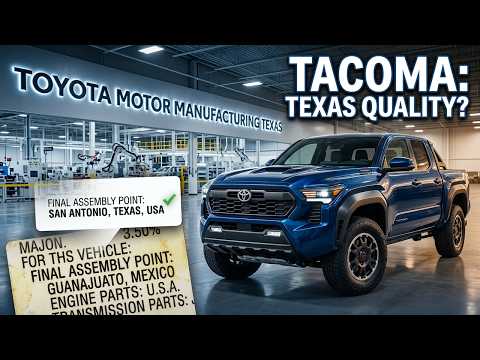
If you've been following Tacoma news lately, you already know something big is brewing in San Antonio. As shown in our thumbnail above, Toyota is making a massive investment that could reshape how your next Tacoma is built — and more importantly, how well it's built. We're diving deep into Toyota's newly announced $3.6 billion expansion and what it really means for current and future Tacoma owners.
The $3.6 Billion Announcement: What's Actually Happening
Toyota just dropped a major announcement that has the entire Tacoma community buzzing. The automaker is investing $3.6 billion into its San Antonio, Texas manufacturing facility — a move that includes adding a second full assembly line and creating approximately 2,000 new jobs in the region.
But here's the part that matters most to us as Tacoma owners and enthusiasts: Toyota plans to shift Tacoma production from its Baja California, Mexico facility to Texas by 2030. Meanwhile, production at the Guanajuato, Mexico plant will continue as-is, meaning we'll likely see a hybrid manufacturing approach for the foreseeable future.
Texas vs. Mexico Production: Does It Actually Matter?
This is the question we get asked constantly in the comments and on the Tacoma forum: does where a truck is built actually impact its quality? It's a fair question, and the answer isn't as simple as "Made in USA = better."
What we do know is that Toyota's Texas expansion isn't just about assembly — it's also tied to bringing more component manufacturing stateside, including engines and transmissions. Domestic sourcing for major drivetrain components could mean tighter quality control, reduced supply chain complexity, and potentially faster response times when issues do arise.
Current Tacoma Build Quality Concerns
Let's be honest with each other — the current generation Tacoma hasn't been perfect. We've heard from countless owners in our community about a few recurring pain points:
- Paint quality issues — Some owners have reported inconsistent paint application and durability concerns, particularly on certain color options
- Lower trim interior quality — The base and mid-level trims have drawn criticism for interior materials that feel like a step back compared to what buyers expect from Toyota
- Build consistency — Panel gaps, trim fitment, and general assembly quality have been inconsistent across production runs
These aren't just anecdotal complaints from disgruntled owners — they're patterns we've tracked across owner forums, our own viewer submissions, and official channels.
What the NHTSA Data Tells Us
When you want the real story on vehicle reliability, you go straight to the source: NHTSA complaint data. We dug into the recent complaint and recall trends for the current Tacoma generation, and there are some important patterns worth discussing.
Brake Hose Recall
One of the more significant recalls affecting Tacoma owners involved brake hose issues. This isn't a minor cosmetic concern — brake system integrity is safety-critical, and recalls like this understandably shake owner confidence.
Driveshaft Recall
We've also seen a driveshaft-related recall impact a portion of the Tacoma lineup. For a truck marketed heavily toward off-roaders and overlanders who put serious stress on drivetrain components, this is exactly the type of issue that gets our community's attention.
Transmission Complaint Trends
Perhaps the most talked-about issue in our comments section has been transmission-related complaints. Whether it's shift quality, hesitation, or other drivability concerns, transmission feedback has been a recurring theme in owner reports filed with NHTSA.
Will Texas-Built Tacomas Actually Be Better?
Here's where we have to be honest with our community: there's no guarantee that a change in manufacturing location automatically fixes quality issues. Quality control comes down to processes, training, supplier relationships, and Toyota's internal standards — not just geography.
That said, there are reasons for cautious optimism:
- New assembly lines often incorporate updated manufacturing technology and processes
- Domestic engine and transmission production could reduce shipping-related component damage and improve supply chain oversight
- Toyota's significant financial investment suggests a long-term commitment to getting this right
- Fresh facilities sometimes mean fresh quality control protocols
However, we won't know for certain until Texas-built Tacomas start rolling off the line and owners begin reporting their real-world experiences.
What This Means for Current and Future Tacoma Owners
If you're currently shopping for a Tacoma or you're an existing owner keeping tabs on the platform's evolution, here's our take: this Texas move represents Toyota's acknowledgment that quality and production efficiency need attention. The 2030 timeline gives Toyota years to refine the transition, but it also means Baja-built trucks will continue rolling off the line for several more years.
For those in the market now, we always recommend thorough pre-purchase inspections, checking build dates, and staying plugged into community resources where real owners share real experiences — good and bad.
Stay Connected With the Tacoma Community
Want to dive deeper into build quality data, ongoing recalls, and everything happening with the Tacoma platform? Head over to the Tacoma forum to connect with thousands of owners sharing real-world experiences. You can also check out our discounts, blog, and organized video library at Smoky Mountain Taco.
Looking to upgrade your rig regardless of where it was built? Browse mods and accessories at the Tacoma Store or find it in the Shop app by searching "Tacoma Store."
For sponsor deals, affiliate links, and exclusive discount codes, visit our sponsors page.
Final Thoughts
Toyota's $3.6 billion Texas investment is a significant move that signals long-term commitment to the Tacoma platform in North America. While it's too early to declare victory on quality improvements, the combination of domestic engine/transmission production, new assembly infrastructure, and thousands of new manufacturing jobs suggests Toyota is taking build quality concerns seriously.
As always, we'll keep tracking NHTSA data, recall trends, and owner feedback as this transition unfolds through 2030. Stay tuned to the channel for updates as more details emerge.